
How to Know If Your Marketing Is Working: Metrics That Actually Matter
In every growing business, there comes a moment when marketing stops being a creative exercise and becomes a financial one. “Is our marketing actually working?”
It reads like a yes-or-no question, yet answering it requires more than dashboards — it demands the integration of data, insights, and business context into a clear narrative that supports decision-making.
Consider a company that invests significantly in a new website. The design is refreshed, the content is refined, and leadership views it as a major milestone. Within weeks of launch, the CEO requests a performance update. GA4 offers an abundance of data, but minimum clarity on business impact. Are the right audiences visiting? How many of them are contributing to pipeline? And has the investment translated into measurable revenue growth?
This situation is common across organizations. Marketing teams have more data than ever, yet little of it translates into insights. When every chart looks positive, it becomes difficult to tell whether marketing is creating progress or simply producing numbers. The first step toward meaningful measurement is separating what merely looks good from what truly drives business outcomes.
What Doesn’t Matter
Vanity metrics measure exposure, not effectiveness. They indicate that something happened, not that it worked. Their appeal lies in immediacy: they move fast, look positive, and are easy to track. But they rarely connect to outcomes that shape the business.
Website traffic may rise after a redesign, yet if those visitors aren’t qualified or converting, the impact is superficial. A paid campaign can deliver hundreds of leads, but if few advance to opportunities or revenue, the spend has created volume without value. These metrics describe motion, not progress.
Vanity metrics can inform early diagnostics but should never define performance. Marketers and business leaders must learn to filter them out and focus instead on indicators that tie effort directly to commercial results.
What Actually Matters
Meaningful marketing measurement requires structure. Numbers only become insight when they are organized around business logic. Two complementary views help achieve that: a funnel view, which tracks how marketing influences progression through the customer journey, and a performance-pillar view, which evaluates the health and efficiency of the entire marketing system.
1. The Funnel View: Connecting Stages to Outcomes
The funnel view treats marketing as a continuum, not a collection of disconnected activities. Each stage has a purpose, and each produces metrics that indicate whether prospects are advancing toward revenue.
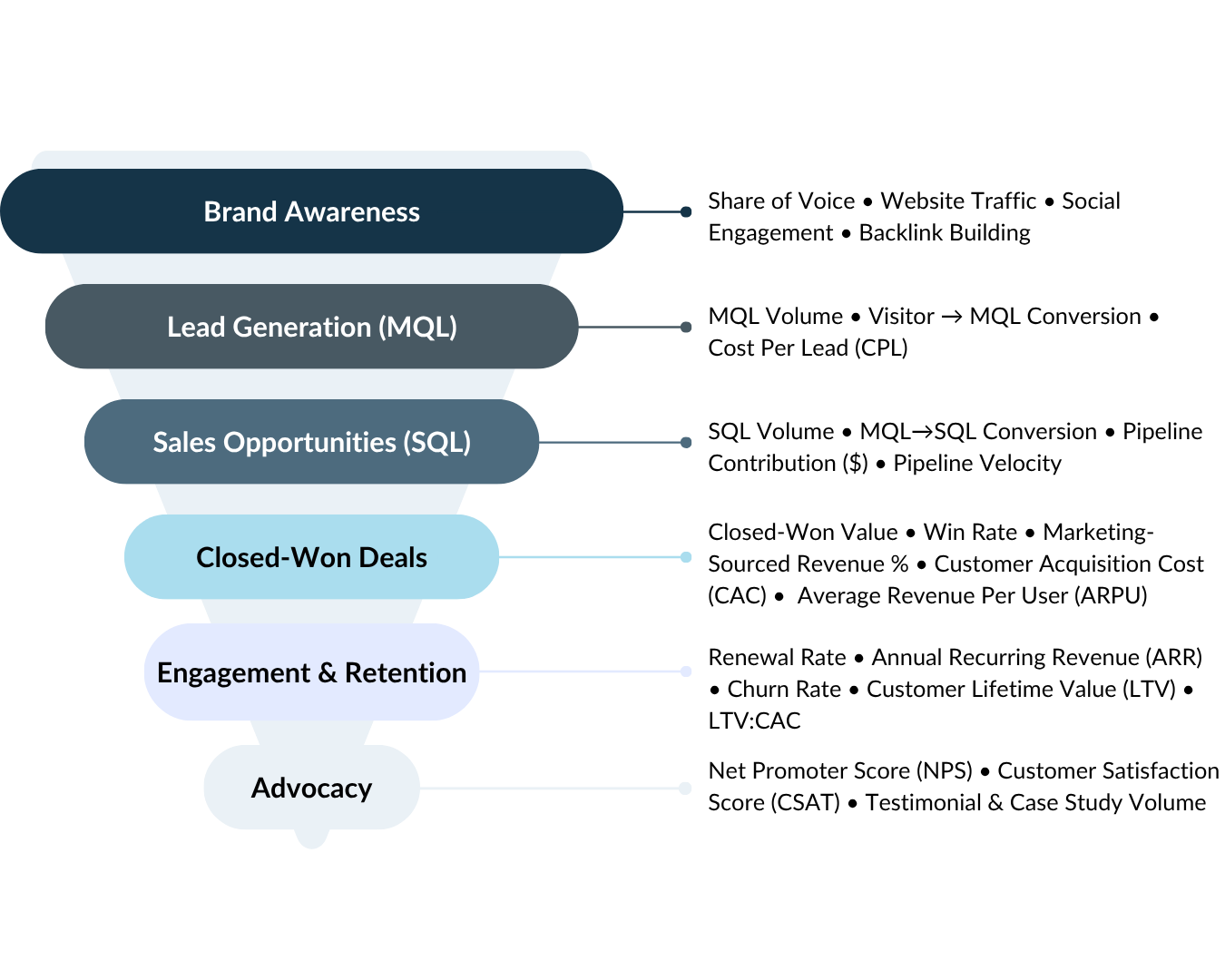
Brand Awareness reflects visibility among the right audiences. It measures how effectively the market recognizes the brand and recalls its value proposition. Metrics such as branded search volume, organic reach, and share of voice help determine whether awareness is expanding within the intended segments.
Lead Generation (MQL) marks the shift from attention to interest. Here, marketing captures identifiable interest — form submissions, demo requests, or content downloads — but only when they originate from prospects that fit the target profile. Quality matters more than volume.
Sales Opportunities (SQL) represent the handoff from marketing to sales. This stage tests marketing’s precision: how many qualified leads convert into real opportunities, how much pipeline they represent, and what percentage of total pipeline marketing has sourced or influenced.
Closed-Won Deals quantify direct commercial impact. Metrics such as win rate, average deal size, and marketing-sourced revenue illustrate whether campaigns are driving measurable return, not just activity.
Engagement & Retention capture post-sale value. Marketing’s role does not end with acquisition; it extends into customer success through onboarding, product engagement, and renewal support. Retention rate, customer lifetime value, and upsell growth are key indicators.
Advocacy reflects the strength of customer belief. Testimonials, referrals, and community participation signal that marketing has not only acquired customers but cultivated advocates who expand the brand’s reach organically.
When tracked together, these stages form a connected narrative from awareness to advocacy — a framework that links marketing investment to business outcomes with clarity and precision.
2. The Performance-Pillar View: Evaluating Marketing as a System
If the funnel view tracks progression, the performance-pillar view evaluates quality. It examines marketing through five dimensions that together indicate strategic and operational strength.
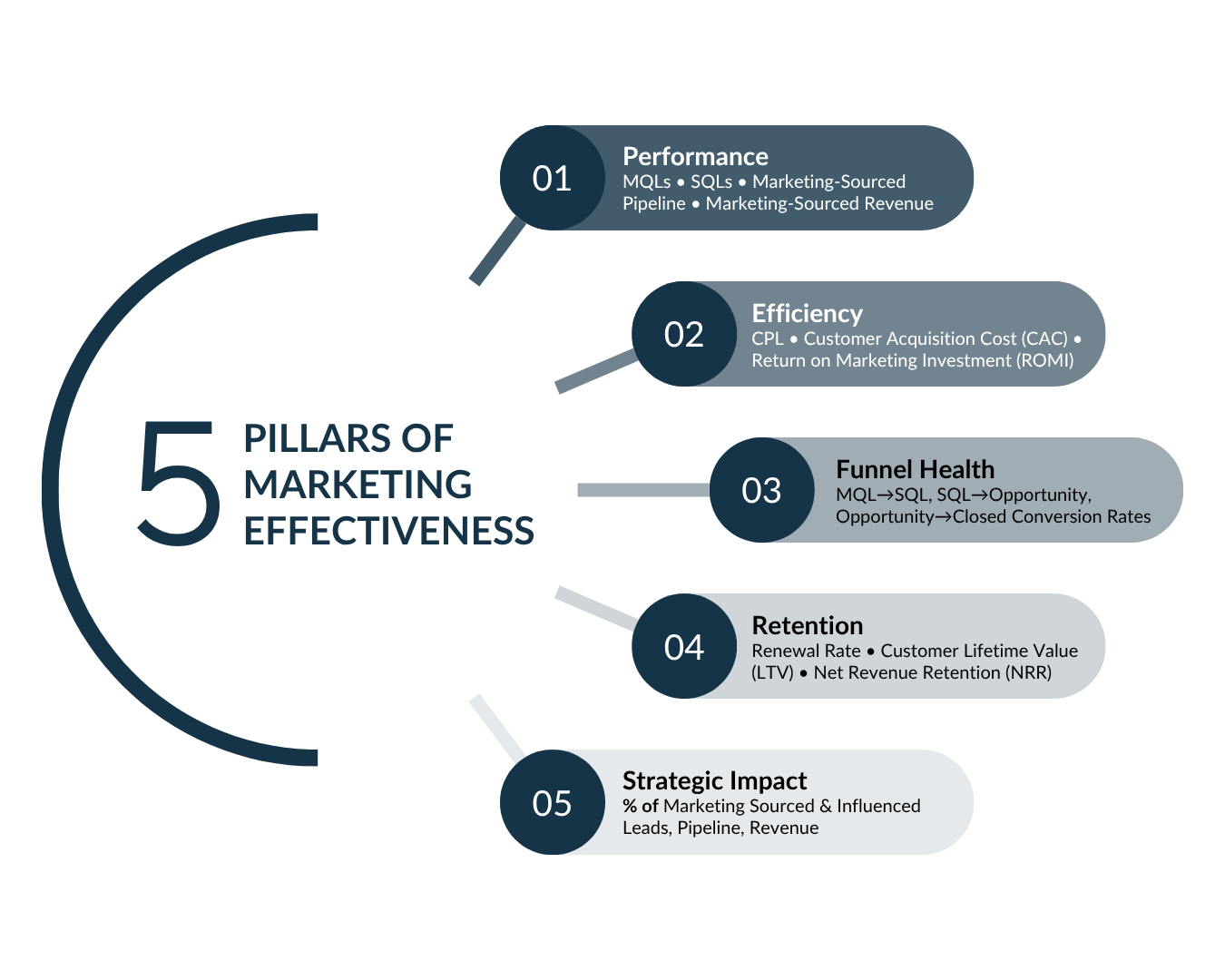
Performance measures marketing’s direct output — qualified lead volume, pipeline contribution, and revenue influence. It answers whether marketing is producing material results.
Efficiency assesses resource utilization. Metrics such as cost per lead, cost per acquisition, and return on marketing investment show how effectively budget converts into measurable value.
Funnel Health examines conversion dynamics. Stage-to-stage ratios and sales-cycle length expose bottlenecks or misalignment between marketing and sales processes.
Retention measures durability. Renewal rate, customer lifetime value, and churn indicate whether marketing helps sustain revenue beyond the initial sale.
Strategic Impact measures marketing’s relative contribution to overall business outcomes compared with other growth drivers such as sales, partnerships, or outbound activities. It quantifies how much of the company’s performance can be attributed to marketing versus non-marketing sources. This perspective not only clarifies marketing’s effectiveness and return on investment, but also helps business leaders understand the broader performance mix — identifying where growth truly originates and where additional resources can generate the greatest impact.
Together, these pillars provide a balanced scorecard for marketing performance. They move the conversation from isolated metrics to system health.
From Numbers to Decision Intelligence
When leaders ask how marketing is performing, they are seeking insights, not numbers. The right answer connects activity to impact by showing how marketing drives qualified pipeline, revenue, and retention.
If your reports are full of numbers but short on meaning, it may be time to redefine what success looks like. At CatalystCraft, we help organizations build measurement frameworks that turn data into strategic decisions and marketing into a growth engine.
Book a discovery call to explore how we can help you measure what matters and maximize your marketing’s impact.
