

Building Marketing Operations
The Growth Engine Behind a Scale-Up
In a tech scale-up, marketing is often celebrated for its creativity, buzz, and lead volume. But without an operations backbone, leads tend to leak, teams spin on tactical firefighting, and growth becomes erratic. Marketing Operations is the infrastructure that transforms marketing from art into an engine, providing rhythm, alignment, accountability, and predictability.
When I joined this organization, that backbone didn’t exist. What I inherited was a fractured system struggling under outdated tools, poor data, and no coherent process. In short, the company’s ambition for growth was far ahead of its operational readiness.

The Starting Line: What Was Holding the Scale-Up Back
Antiquated Technology and Inefficient Execution
The existing tech stack was outdated. It lacked integration, automation, and flexibility. Campaigns required manual workarounds; alignment with sales was tenuous. The technology simply could not support a growing pipeline.
Siloed, Fragmented Reporting
Reporting was narrow and surface-level, focused mostly on lead-generation metrics such as form fills and email clicks or opens. There was little connection to pipeline, no forecasting, and certainly no view into mid- or bottom-funnel impact.
Weak (or Non-existent) Process Discipline
Where processes did exist, adherence was arbitrary at best. Teams routinely bypassed or modified workflows, creating inconsistency and confusion. Campaigns were launched in silos, handoffs were poor, and there was no sense of a unified operating rhythm.
Abysmal Data Quality
The foundational database was a mess. Duplicate records, missing fields, inconsistent naming, and outdated entries eroded confidence in every analytical effort. On top of that, undisciplined and unaligned data entry by cross-functional teams turned the CRM from a communication enabler into a source of friction, undermining both collaboration and visibility. Any segmentation, scoring, or personalization built atop it was shaky at best.
Zero Project Management Mindset
Projects were ad hoc, loosely tracked, and lacked accountability. Cross-team initiatives — product launches, campaigns, or cross-functional integrations — were often delayed, misaligned, or reworked multiple times due to gaps in coordination.
Building the Engine: Pillars of the Marketing Operations Function
Rather than tackling all parts at once, I approached each pillar in sequence, yet always with the holistic vision of an integrated growth engine. Here’s how it unfolded, and how your scale-up can replicate these steps.
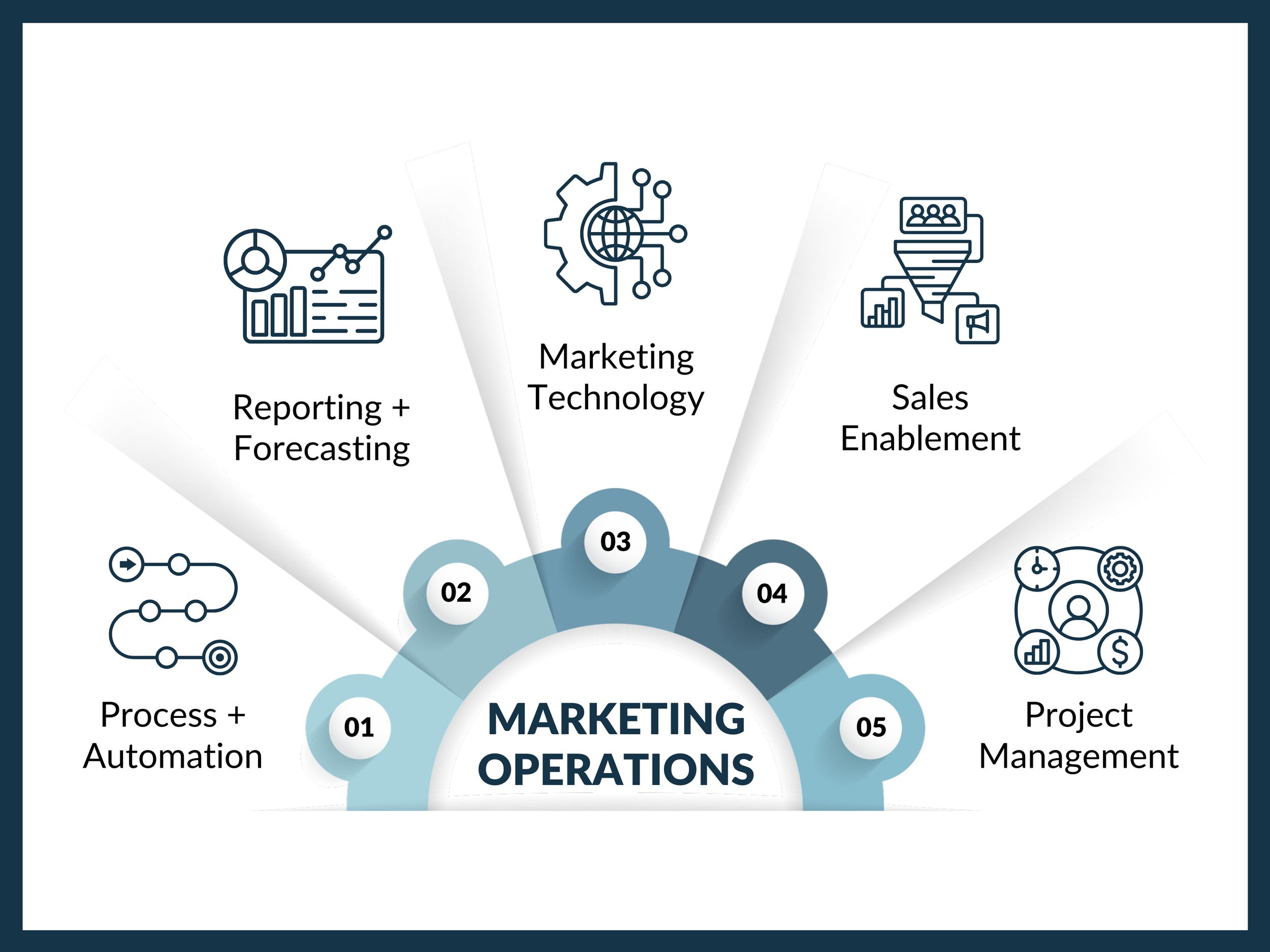
Process + Automation: Engineering Consistency
The first investment was process discipline. I built standardized flows for campaign intake, creative brief, list operations, lead nurturing, and sales handoff — enforced through operations playbooks and marketing automation.
A prime illustration of this is when I led the automatization of Customer Engagement and Retention Program, consolidating processes across acquisition, onboarding, engagement, renewal, and advocacy into one cohesive framework, orchestrated in one, automated system.
Over time, process became second nature that is embedded in how the team planned, executed, and measured every initiative. What once required manual reminders and oversight evolved into a disciplined operating rhythm that drove consistency, accountability, and scale.
Reporting & Forecasting: From Vanity to Results
Once processes and data flow stabilized, I built a multi-layer reporting structure that connected marketing activity to pipeline, deals, and revenue. The goal was to give executives clear visibility into marketing ROI and surface insights that could directly inform growth decisions.
The Revenue Operations Reporting Transformation illustrates how I evolved reporting from mere lead counting into a full-funnel intelligence system with monthly, quarterly, and annual layers. These dashboards didn’t just measure activity, they are the foundation for accurate forecasting. By connecting historical performance, conversion trends, and pipeline velocity, the system enabled leadership to anticipate outcomes, set realistic targets, and allocate budgets with confidence. Forecasting, in turn, reinforced reporting, allowing the team to measure progress against goals, identify variances early, and stay aligned with business growth objectives. Together, reporting and forecasting became the organization’s compass, turning data into forward-looking insight and operational control.
MarTech: Replacing Legacy with Scalable Infrastructure
Technology was not just “one tool upgrade”, it was a re-imagining of how marketing and sales operate together. I phased out legacy systems and implemented a modern, integrated stack that supported scalability, automation, and cross-functional visibility.
A standout example is the HubSpot Implementation with Dynamics Integration, where I led the replacement of a constrained legacy automation plugin with full HubSpot + Microsoft Dynamics integration. The result: 40% faster lead handoff, 30% faster campaign execution, and 50% higher pipeline attribution within the first quarter.
This upgrade created a unified ecosystem, eliminating silos and accelerating execution.
Sales Enablement & Data Integrity: Connecting the Revenue Dots
Marketing operations must bridge to sales. That means clean, trusted data, shared definitions of funnel stages, and a mechanism to enable sales with insights and tools.
In the SDR and Sales Enablement work, I introduced the function as a connective layer between marketing and sales designed to align go-to-market efforts, equip SDRs with the right tools, and turn marketing leads into qualified revenue opportunities. The initiative established a middle-of-funnel framework that gave SDRs structured playbooks, clear processes and cadences, and data-driven prioritization models to focus effort where it mattered most. Marketing operations became the engine behind this system, ensuring SDRs had the intelligence, automation, and content resources needed to perform effectively.
This alignment not only reduced friction between teams but also ensured every lead was nurtured, qualified, and handed off with precision. Underpinning the entire effort was a data cleanup and governance program — standardizing formats, merging duplicates, and enforcing consistency — so that every SDR could trust the CRM as a single source of truth.
Project Governance: Discipline at Scale
As the marketing operations function matured, I introduced a project governance model that treated every campaign as a structured project — each with defined planning, execution, launch, reporting, and optimization phases. This framework brought clarity, transparency, and accountability to every initiative. Campaigns were no longer ad hoc activities; they became managed programs with clear owners, timelines, and measurable outcomes.
Cross-functional collaboration became the standard operating mode. Product, marketing, SDRs, sales, and customer success worked as one unified team, each playing a defined role in execution and feedback loops. No campaign moved forward in isolation — every initiative was linked to business goals, sales priorities, and customer outcomes.
This governance structure also elevated how go-to-market efforts were managed at scale. Product launches and demand programs were consolidated into a portfolio aligned with company strategy and revenue targets. With shared visibility and consistent checkpoints, teams could plan proactively, adapt in real time, and deliver programs with greater efficiency and confidence.
Impact: How This Shift Transformed Growth
By weaving together process, reporting, technology, enablement, and governance, the marketing operations function became a core growth driver.
Operational velocity and consistency improved significantly. Campaigns launched faster, pipelines moved smoother, and surprises were minimized.
Forecasting and visibility became real. Leadership could see weeks or months ahead, reducing guesswork in investment and resource allocation.
Sales–Marketing alignment transformed from tension to synergy. SDRs and AEs had confidence in lead quality, and marketing knew which levers truly moved deals.
Tech overhead decreased, and scalability increased. The modern stack supported additions, integrations, and new channels with minimal friction.
Strategic credibility grew. Marketing ceased being a “cost center” and became a measurable contributor to revenue growth.
In a scale-up environment, you can’t afford to let infrastructure lag behind ambition. A thoughtfully built marketing operations function is the engine behind predictable, scalable growth, and it’s the difference between hoping for traction and engineering it.